

If you’ve spotted the phrase “quasi meaning” in a text message, an online forum, or a Discord server and weren’t sure what it meant, you’re not alone. It sits in that odd space between formal English and everyday slang, leaving many people second-guessing themselves. Is it academic jargon? Gen Z lingo? A prefix? All of the above?
The short answer: “Quasi meaning almost, seemingly, or partially, describing something that resembles something else without being the real deal. But there’s a lot more nuance worth knowing, especially as this word pops up more frequently in digital conversations in 2025.
This guide breaks down the full “quasi meaning” meaning, its history, how people use it in real chats, common mistakes to avoid, and related words you should know.
What Does “Quasi” Mean in Chat or Text?
In online chats and text messages, “quasi” is used to mean “kind of,” “sort of,” or “almost” — but with a slightly more precise or witty edge. It signals that something partially fits a description without fully qualifying as that thing.
Quick definition:
Quasi — adjective/prefix/adverb — Seemingly; apparently but not really. Having some but not all features of something.
So when someone texts “I’m quasi-ready”, they mean they’re almost ready but not quite there yet. When a friend says “that’s a quasi-plan,” they’re suggesting it’s like a plan — but loosely put together.
It’s not strictly slang. Quasi is a real English word (and Latin-origin prefix) that has found its way into casual digital conversation because it adds precision without extra words.
Origin and History in Online Chats
The word “quasi” traces back to classical Latin, where it meant “as if” or “just as.” It derives from the compound quam sī, directly translating to “as if.” Latin scholars and philosophers used it to describe things that resembled something without being an exact match.
It entered the English language centuries ago, mostly in legal, academic, and philosophical writing — phrases like quasi-contract and quasi-judicial were common in law texts. Over time, it crossed into general use as a hyphenated prefix (quasi-official, quasi-scientific, quasi-celebrity).
The shift into online chat happened naturally. As internet culture developed, forum users, students, and professionals started dropping “quasi” into casual conversation for its versatility. By the mid-2010s, it was appearing in Reddit threads, academic Discord servers, and even casual texting. In 2025, it’s a recognized part of digital vocabulary—especially among people who want to say “kind of” but in a more deliberate, expressive way.
How People Use “Quasi” in Real Conversations
Understanding the “quasi” definition is one thing—knowing when to use it is another. It works in a surprisingly wide range of situations.
When It’s Appropriate
Quasi works best when
- You want to describe something that almost fits a category but not entirely
- You’re drawing a comparison with a small caveat
- You want to be precise without writing a long explanation
- The conversation has a slightly formal or intelligent tone
Common real-life uses:
| Context | Example | Meaning |
|---|---|---|
| Work/professional | “It’s a quasi-official decision.” | Semi-official, not fully confirmed |
| Social plans | “We have a quasi-plan for Friday.” | A loose idea, not a real plan |
| Relationships | “He’s a quasi-friend.” | Somewhere between acquaintance and friend |
| Gaming/Discord | “The patch is quasi-broken.” | Mostly broken, partially working |
| Academic | “It’s a quasi-experimental design.” | Resembles an experiment but lacks full controls |
Quasi is versatile because it can attach to nouns (quasi-celebrity), adjectives (quasi-official), and stand alone as an adverb (“I’m quasi-ready”).
When It Feels Awkward
Like any word, “quasi” has its limits. Use it incorrectly and it comes across as stiff, try-hard, or just confusing.
Avoid using quasi when:
- Your audience is very casual and prefers simple slang (“kinda” works better in a quick text to a close friend)
- The context is fully serious or formal — it can sound dismissive
- You’re replacing it for a word that already exists and fits perfectly
- You’re overusing it in every other sentence — it loses its impact fast
For instance, texting “quasi lol” to your best friend without context will likely just confuse them. But saying “it was a quasi-date — we hung out but never called it that” in a group chat? Totally natural.
Real-Life Examples of “Quasi” in Text Messages
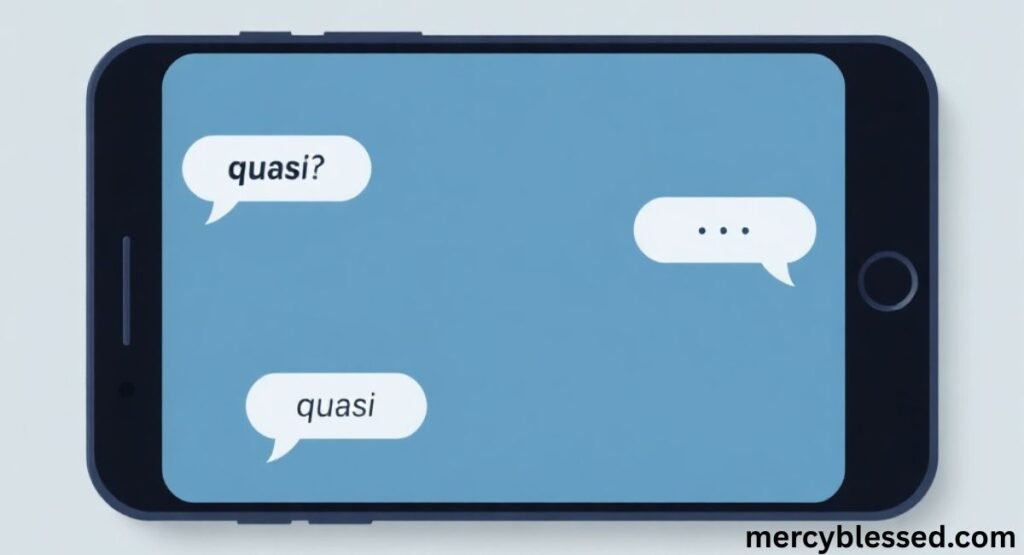
Seeing it in context makes it click. Here are realistic text and chat scenarios showing how quasi actually appears in digital conversations:
Example 1 — Making weekend plans:
Friend 1: Are you ready for Saturday? Friend 2: Quasi. I still need to book the restaurant but otherwise yeah.
Here, quasi signals partial readiness — almost there, not fully.
Example 2 — Describing a new game:
Gamer 1: Is the new update good? Gamer 2: Quasi. The graphics improved but the bugs are still everywhere.
Quasi here = partially good, with reservations.
Example 3 — Talking about relationships:
Friend 1: Are you two dating? Friend 2: It’s quasi-dating. We’re hanging out but nothing’s official.
A classic quasi usage — almost a category, not fully in it.
Example 4 — Work or school situations:
Colleague: Did the boss confirm the new policy? You: It’s quasi-confirmed. She mentioned it but nothing’s in writing.
Professional, precise, totally natural.
Example 5 — Social media / caption style:
“Quasi-vacation mode activated. Still answering emails but sitting by a pool 🌊”
Relatable, clever, widely used on Instagram and Twitter.
Common Mistakes & Misunderstandings

Even smart people misuse “quasi.” Here are the most frequent errors and how to fix them:
1. Thinking it means “completely” or “very.” This is the most common mistake. “Quasi” does not intensify a word — it reduces it. “Quasi-expert” means someone who is somewhat expert-like, not a full expert.
2. Treating it as pure slang, Quasi isn’t slang in the traditional sense. It’s a legitimate English word and a prefix with centuries of use. It just happens to fit into casual conversation naturally.
3. Misspelling it as “quazi” or “quaisi.” The correct spelling is always q-u-a-s-i. No ‘z’, no extra vowels.
4. Overusing it for everything Using quasi in every other sentence makes you sound robotic. Save it for moments where “kind of” or “sort of” don’t quite capture the nuance.
5. Confusing it with “quasi” as a character name Some people recognize “Quasi” from The Hunchback of Notre Dame (Quasimodo). That’s a proper noun — different from the descriptive word.
Related Slangs & Abbreviations
If you love using quasi, you’ll probably find these related words and modern slang alternatives useful too:
| Word/Phrase | Meaning | Formality Level |
|---|---|---|
| Kinda | Kind of / somewhat | Very casual |
| Sorta | Sort of / partially | Very casual |
| Semi- | Half / partly (prefix) | Neutral |
| Pseudo- | False or imitation (prefix) | Formal/academic |
| Virtually | Almost entirely, practically | Neutral-formal |
| Essentially | In effect, mostly | Neutral-formal |
| Borderline | Almost crossing into a category | Casual-neutral |
| Lowkey | Moderately / kind of (Gen Z slang) | Very casual |
| Technically | Strictly speaking, not fully | Casual-neutral |
| So-called | Named as such, but questionable | Neutral |
Quasi vs. Pseudo: These are often confused. Pseudo implies something is fake or deceptive (pseudo-science = false science). Quasi simply means it resembles something without fully being it—no deception implied.
Quasi vs. Semi: Semi means half (semi-circle = half circle). Quasi means almost like or resembling — it’s about likeness, not halves.
FAQs
What does “quasi” mean in simple terms?
It means “almost” or “kind “of”—something that resembles another thing but isn’t quite that thing fully.(Quasi Meaning)
Is “quasi” a slang word?
Not exactly. It’s a formal Latin-origin word used casually. It’s more of a precise informal qualifier than true slang.
Can I use “quasi” in a text message?
Yes, especially in semi-casual or intelligent conversation. In very casual texts, kinda or sorta may flow more naturally. (Quasi Meaning)
Is it “quasi” or “quazi”?
Always quasi—spelled with an ‘s’, not a ‘z’. This is one of the most common spelling mistakes.
What part of speech is “quasi”?
It functions as an adjective, an adverb, and a prefix depending on context.
Does “quasi” mean fake?
No. “Quasi” means resembling or partially like something—it does not suggest fakeness or deception the way pseudo does.
Is “Quasi Meaning used in professional settings?
Absolutely. “Quasi” is common in legal (quasi-contract), academic (quasi-experimental), and business contexts (quasi-official).
Conclusion
The word “Quasi Meaning” is one of those rare terms that bridges formal language and casual conversation effortlessly. Whether you’re texting a friend about your quasi-plans for the weekend, describing a quasi-official office memo, or dropping it in a Discord server to sound precisely clever—understanding what it means and how to use it correctly makes your communication sharper.

hi