

If you’ve ever been mid-conversation on TikTok, Snapchat, or a group chat and seen someone drop “LWK Meaning” out of nowhere, you’re not alone. It’s one of those short forms that looks like a typo but is actually one of the most common pieces of Gen Z texting slang. This guide breaks down exactly what LWK means, where it comes from, how it’s used across different apps, and how to figure out which meaning applies when the context isn’t obvious.
What Does LWK Mean in Text? (The Complete Definition)
In nearly every modern chat, LWK is short for “low-key.” It’s used to soften a statement, admit a feeling quietly, or share an opinion without making a big deal out of it. Think of it as a digital version of saying “kind of” or “honestly, but I’m not shouting about it.”
That said, LWK isn’t a single-meaning acronym carved in stone. Like a lot of internet slang, its meaning has shifted and branched depending on who’s using it and where. Below are the three interpretations you’re most likely to run into.
LWK Meaning — Low-Key (The Most Used Interpretation)
This is, by far, the dominant meaning. “Low-key” is a phrase that’s existed in English for decades, originally describing something subtle or understated. Texting culture simply trimmed it down to save keystrokes, the same way “to be honest” became “tbh” and “in my opinion” became “imo.”
When someone uses LWK this way, they’re usually:
- Admitting a feeling without overstating it
- Sharing an opinion they don’t want to seem too intense about
- Softening a confession so it feels casual rather than dramatic
Example: “I’m LWK nervous about the interview tomorrow.” This means the person is nervous, but they’re downplaying it rather than making it sound like a huge deal.
LWK Meaning — Love With Kisses
A much less common but still real interpretation, especially in older texting and SMS contexts, is “Love With Kisses.” This version tends to show up in affectionate or sign-off messages rather than mid-sentence opinions.
Example: “Goodnight, LWK.”
If LWK appears at the very end of a message, almost like a signature, there’s a decent chance the sender means something closer to a warm, affectionate closing rather than “low-key.”
LWK Meaning — Laughing Without Kidding
A rarer, more niche usage treats LWK as a way to say someone is genuinely laughing, not just joking around. It’s not nearly as widespread as the “low-key” meaning, but it does pop up occasionally in specific friend groups or online communities that have adopted their own shorthand.
Example: “That video had me LWK, I couldn’t stop.”
Because this meaning overlaps conceptually with laughing acronyms like “lol” or “lmao,” it’s easy to misread — which is exactly why context matters so much (more on that below).
How LWK Is Used Across Different Platforms
LWK doesn’t change its core meaning much from app to app, but the way it’s used—tone, placement, and frequency—does shift depending on the platform.
| Platform | Typical Usage | Common Tone |
|---|---|---|
| TikTok & Instagram | Captions, comments, replies | Casual, relatable, sometimes humorous |
| Snapchat & WhatsApp | Private chats between friends | Personal, honest, low-pressure |
| Twitter/X | Quick reactions, quote posts | Blunt, sarcastic, opinion-driven |
LWK on TikTok and Instagram
On these platforms, LWK shows up constantly in comment sections and captions. It’s often used to admit something relatable in a way that feels self-aware rather than serious.
- “LWK this trend is kind of addictive”
- “She’s LWK talented ngl”
Because these platforms are built around short, punchy text, LWK fits naturally alongside other slang like “ngl” (not gonna lie) and “fr” (for real).
LWK on Snapchat and WhatsApp
In private messaging apps, LWK tends to feel more personal. Since these are one-on-one or small-group chats, LWK is often used to admit real feelings without sounding overly emotional.
- “LWK missed talking to you”
- “I’m LWK stressed about finals”
LWK on Twitter/X
On X, LWK often appears in fast, opinion-heavy posts. The platform’s culture rewards blunt takes, so LWK is frequently used to soften an otherwise strong statement.
- “LWK this season was mid.”
- “LWK can’t believe that happened.”
LWK Usage Examples in Real Conversations
Seeing LWK in a realistic back-and-forth makes the meaning click faster than any definition alone. Here are a few sample exchanges:
- A: “Did you like the movie?” B: “LWK it was better than I expected. 😂”
- A: “Are you mad at him?” B: “LWK yeah, but it’s fine.”
- A: “How’s the new job going?” B: “LWK kind of overwhelming, but I’m figuring it out.”
- A: “That outfit is fire.” B: “LWK thank you, I wasn’t sure about it lol.”
In each case, LWK adds a layer of honesty while keeping the tone relaxed rather than dramatic.
How to Tell Which LWK Meaning Is Being Used
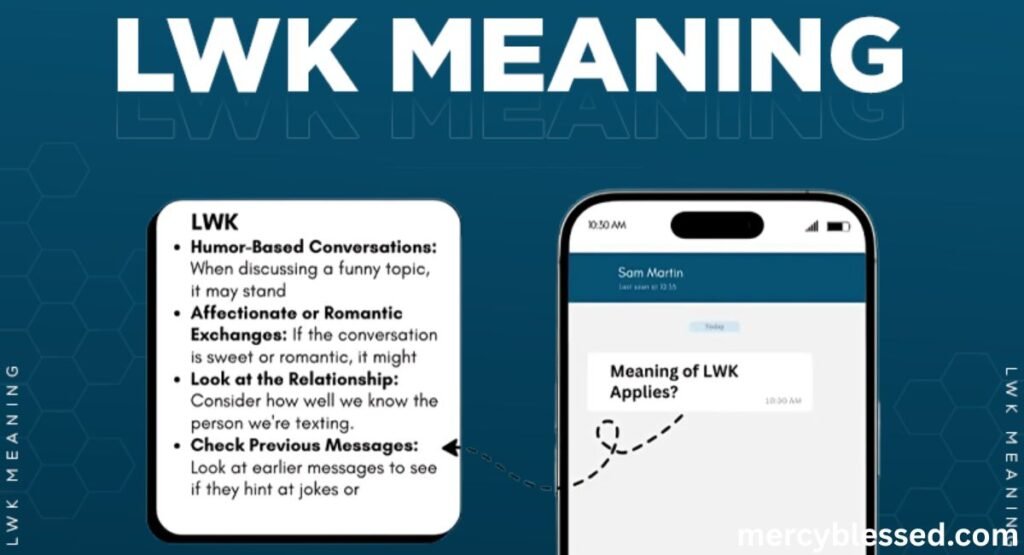
Since LWK can technically mean three different things, context becomes the deciding factor. Here’s how to read the room.
Clues From Sentence Position
If LWK appears in the middle of a sentence, right before an opinion or feeling, it’s almost always “low-key.”
- “I LWK think you’re right” → low-key
- “LWK, love you” → could lean toward affection, depending on the sender
Clues From Your Relationship With the Sender
- If it’s a close friend or partner signing off a message, “Love With Kisses” becomes more plausible.
- If it’s someone reacting to a joke, meme, or funny video, “Laughing Without Kidding” is worth considering.
- In most other everyday texting, “low-key” is the safest and most likely interpretation.
Clues From the Platform
Casual social platforms like TikTok, Instagram, and X lean almost entirely toward “low-key.” Private, personal chats occasionally open the door to the affectionate meaning, especially between romantic partners.
What LWK Does NOT Mean — Common Mistakes and Misconceptions
Because LWK doesn’t look like a typical word, it’s often misread. A few clarifications:
- It’s not a typo for “like” or “look.” It’s a standalone abbreviation, not a misspelling.
- It has no official corporate or technical meaning. In everyday texting, it’s not tied to any brand, company, or formal term.
- It’s not rude or aggressive on its own. Tone comes from the surrounding words and emojis, not from LWK itself.
- It’s not interchangeable with “highkey.” “Highkey” (sometimes written HWK) means the opposite—something done openly and without holding back — so mixing the two up can flip the meaning of a message entirely.
- It’s not appropriate for formal writing. Emails, reports, and professional messages should stick with the full phrase “low-key” or avoid the term altogether.
Conclusion
LWK is a small abbreviation that carries a lot of texting personality. In the overwhelming majority of cases, it simply means “low-key” — a way to admit a feeling or opinion without making it sound intense. The less common meanings, “Love With Kisses” and “Laughing Without Kidding,” pop up occasionally, but context, platform, and your relationship with the sender will almost always point you toward the right interpretation. Once you know the signals to look for, you’ll never have to guess what LWK means again.
FAQs
What does LWK Meaning in a text message?
LWK most commonly means “low-key,” used to express a mild, subtle, or understated feeling or opinion. (LWK Meaning)
Is LWK the same as “lowkey”?
Yes, LWK is simply the shortened, typed-out version of “lowkey,” and both carry the same meaning.
Can LWK mean something other than low-key?
Yes, in rarer cases it can mean “Love With Kisses” or “Laughing Without Kidding,” depending on context.
Is LWK appropriate for formal or professional writing?
No, LWK is internet slang and should be avoided in emails, reports, or workplace communication.
What’s the opposite of LWK?
The opposite is “highkey” (HWK), which means something done openly or intensely rather than subtly.
Which platforms use LWK the most?
LWK is most common on TikTok, Instagram, Snapchat, WhatsApp, and Twitter/X, especially among Gen Z users.

hi