

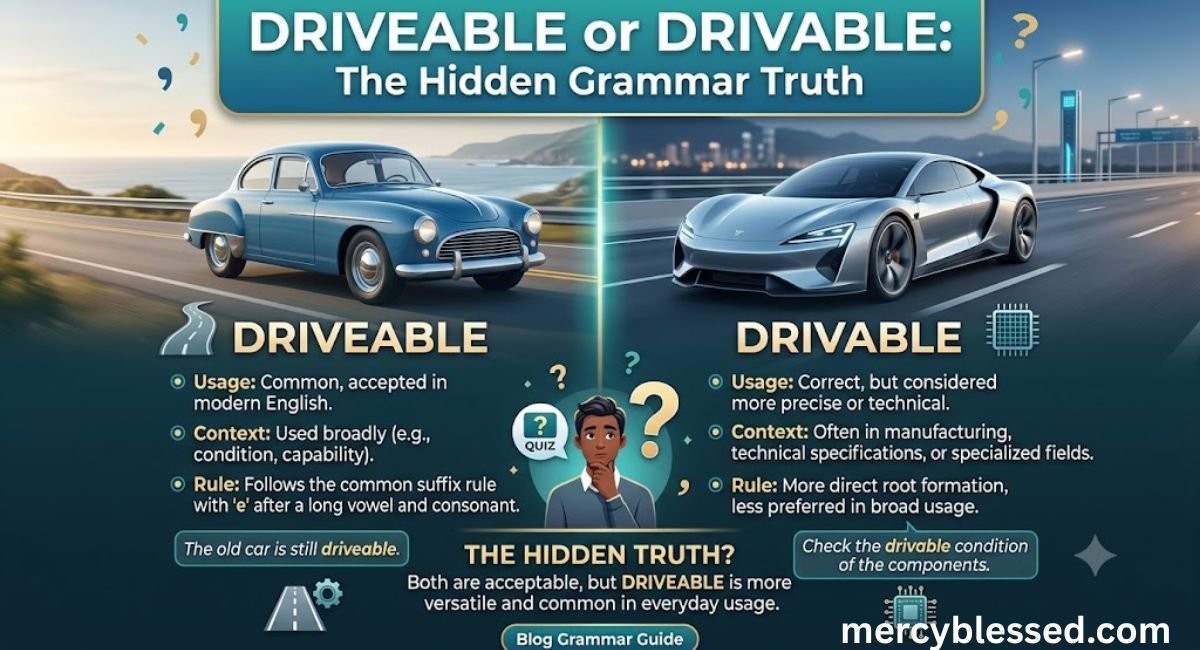
You’re texting a friend about your car after the repair shop finally finished the brakes. You type “the car is dri…” and then freeze. Is it drivable or driveable? Autocorrect doesn’t flag either one, and that’s exactly the problem.
Here’s the short answer: both spellings are correct. Neither is a typo. But which one you should actually use depends on your audience, your region, and a small piece of English spelling history that most people never learn. This guide breaks down exactly where the two words came from, when to use each one, and how real writers and dictionaries treat them today.
What Do Driveable and Drivable Mean?
Both driveable or drivable are adjectives with an identical meaning: capable of being driven, or suitable for driving on.
The word can describe two different things:
- A vehicle that is in good enough condition to be operated safely (e.g., “the truck is drivable after the tune-up”)
- A road, surface, or path that a vehicle can travel over (e.g., “the mountain trail isn’t drivable in winter”)
There is no difference in meaning, tone, or formality between the two spellings. This is purely a spelling variation, not a vocabulary distinction — similar to how “grey” and “gray” describe the exact same color.
The Origin of the Word
To understand why two spellings exist, it helps to trace the word back to its root.
The verb drive comes from the Old English drīfan, meaning “to push forward” or “to force movement.” Over centuries, this evolved into the modern verb “drive,” which by the Middle English period carried the meaning of controlling or steering a vehicle or animal.
When English speakers needed an adjective form, they attached the suffix -able, borrowed from Latin -abilis, meaning “capable of” or “worthy of.” Combined with “drive,” the result should mean “capable of being driven.”
The complication comes from the silent “e” at the end of “drive.” English has a long-standing rule: when adding a vowel-starting suffix like -able to a word ending in a silent e, you typically drop the e. That gives you drivable. But English also has plenty of exceptions where the e is retained — usually to preserve pronunciation or soften a consonant sound, as in “manageable” or “noticeable.” Writers who followed that instinct kept the e in “drive,” producing driveable.
Both spelling paths follow legitimate patterns in English orthography. Neither is a mistake — they’re two different resolutions to the same rule conflict, and that’s exactly why the debate still exists today.
British English vs American English Spelling
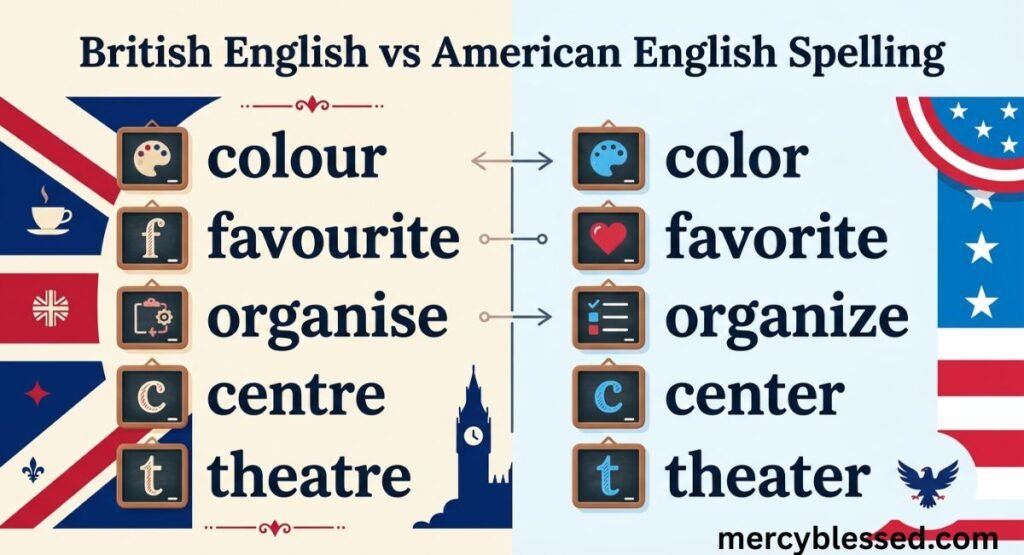
The clearest way to understand the split is geography. This isn’t really a grammar rule at all — it’s a transatlantic spelling divide, much like color vs colour or realize vs realise.
American English: Drivable
American English strictly follows the “drop the silent e before -able” rule. This keeps the word shorter and more phonetically consistent with how it’s pronounced.
- Merriam-Webster lists drivable as the primary and only standard entry
- U.S. newspapers, style guides, and technical writing default to drivable
- It’s the version taught in most American English grammar resources
British English: Driveable
British English, shaped largely by conventions reflected in the Oxford English Dictionary, more often keeps the silent e when the root word could otherwise look ambiguous or lose its visual connection to “drive.”
- Driveable appears more frequently in UK publications, forums, and everyday writing
- It’s recognized as a valid alternative spelling, not a nonstandard error
- Commonwealth English (Australia, Canada in some contexts, New Zealand) leans toward this form as well, though usage varies
| Feature | Drivable | Driveable |
|---|---|---|
| Region | American English | British English |
| Dictionary status | Primary entry (Merriam-Webster) | Valid variant (Oxford, Wiktionary) |
| Formation rule | Drop silent “e” before -able | Retain silent “e” before -able |
| Common in | US media, technical writing | UK media, Commonwealth writing |
| Search popularity | Higher globally | Lower, but steady in UK searches |
Which Spelling Should You Use?
The rule of thumb is simple: write for your audience.
- If you’re writing for a U.S.-based audience, a global brand, or following American style guides (AP, Chicago), use drivable.
- If you’re writing for a UK, Australian, or Commonwealth audience, or matching British house style, driveable is perfectly acceptable.
- If you’re unsure of your audience, default to drivable — it’s the more widely recognized spelling internationally and the one most spell-checkers and style guides prefer.
Whichever version you choose, the golden rule of writing applies here: pick one spelling and stay consistent throughout the same document. Switching between the two mid-article looks like a proofreading error even though both are technically correct.
Common Mistakes with Driveable / Drivable
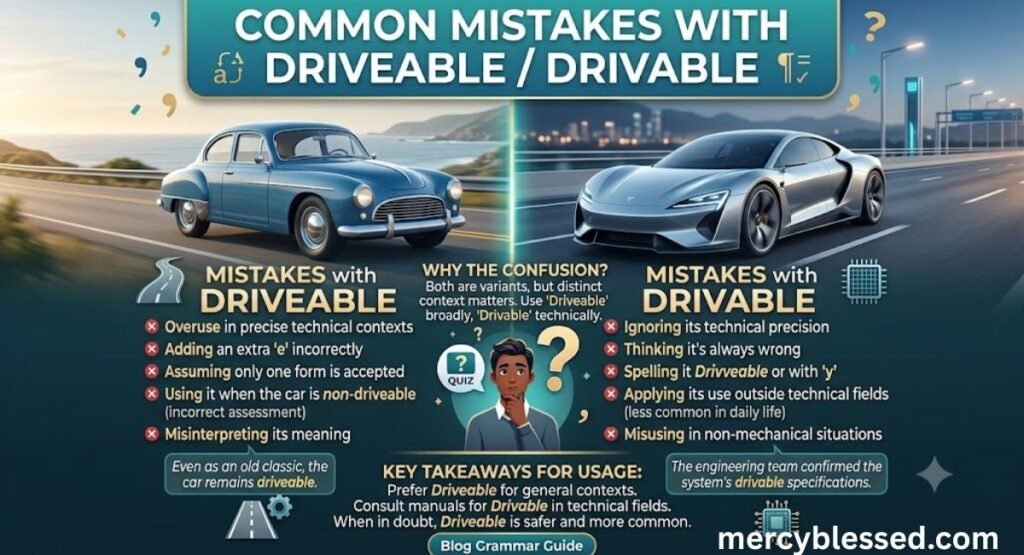
Even confident writers slip up with this word pair. Here are the most frequent issues:
- Mixing spellings in one piece of writing — using “drivable” in paragraph one and “driveable” in paragraph three
- Assuming one spelling is simply wrong — many style guides and grammar sites incorrectly label driveable as a typo, when it’s a recognized regional variant
- Overcorrecting in formal writing — some writers “fix” driveable to drivable in British-audience content, which actually goes against regional convention
- Confusing it with unrelated words — “derivable” (able to be derived) is a completely different word that’s sometimes mistyped as “driveable”
- Ignoring house style guides — many companies and publications have a preferred spelling; skipping that check leads to inconsistency across a website or brand
Driveable or Drivable in Everyday Examples
Seeing both words in context makes the distinction easier to remember.
Using “Drivable”
- The mechanic confirmed the car is drivable after replacing the tire.
- Is this road drivable during a snowstorm?
- The vintage motorcycle, though old, is still fully drivable.
- After the repairs, the sedan became drivable again within a day.
Using “Driveable”
- The estate agent noted the private lane was driveable year-round.
- Our new SUV is remarkably driveable in tight city streets.
- The farm track becomes barely driveable after heavy rain.
- He described the classic car as surprisingly driveable for its age.
Notice that the sentences are interchangeable — you could swap “drivable” for “driveable” in any example above without changing the meaning at all.
Driveable or Drivable — Google Trends & Usage Data
Search behavior offers a practical, real-world view of which spelling people actually use.
Google Trends Summary
- Drivable consistently shows higher global search volume than driveable
- The gap is most pronounced in the United States, where drivable dominates
- In the UK, Ireland, and parts of Australia, driveable narrows the gap significantly, though drivable often still leads overall
- Search interest for both terms tends to spike around seasonal events — after storms, winter road closures, or used-car buying seasons
Corpus Linguistics Insight
Large text databases that track real-world word usage (like the Corpus of Contemporary American English and the British National Corpus) confirm the regional pattern:
- American corpora show drivable appearing far more frequently than driveable
- British corpora show a much closer balance between the two, with driveable holding a meaningful share
- Neither corpus flags driveable as an error — it appears consistently enough across decades of published writing to be treated as an established variant, not a mistake
This data-backed pattern reinforces the same conclusion grammar guides reach: it’s a regional preference, not a right-versus-wrong issue.
Conclusion
Driveable or drivable are two correct spellings of the same word, separated by geography rather than grammar. American English favors the shorter drivable, while British and Commonwealth English commonly retain the e in driveable. Both describe a vehicle or road fit for driving, and neither is technically wrong.
The real key to using this word correctly isn’t memorizing a rule — it’s knowing your audience and staying consistent. Pick the spelling that matches your readers, use it throughout your writing, and you’ll never get tripped up by this quietly tricky word again.
FAQs
Is “driveable” a real word?
Yes. It’s a recognized variant spelling of “drivable,” commonly used in British and Commonwealth English. (Driveable or Drivable)
Which spelling is correct: driveable or drivable?
Both are correct. Drivable is standard in American English; driveable is standard in British English.
Does Merriam-Webster recognize driveable?
Merriam-Webster lists drivable as its primary entry and does not treat driveable as a separate standard headword, though it’s recognized elsewhere, including Oxford-based references. (Driveable or Drivable)
Can I use both spellings in the same document?
You can, but it’s best to pick one spelling and use it consistently to maintain a polished, professional tone.
Does the spelling change the meaning of the word?
No. Both words mean exactly the same thing — capable of being driven or suitable for driving on.
Is “driveable” a typo of “drivable”?
No. It follows a legitimate English spelling pattern of retaining a silent “e” before adding “-able,” similar to words like “manageable.” (Driveable or Drivable)

hi