

For centuries, Catholics have turned to a short, powerful Memorare Prayer whenever life feels uncertain: the Memorare. Whispered in hospital waiting rooms, recited before exams, and prayed quietly during sleepless nights, this brief petition to the Blessed Virgin Mary has comforted generations of believers. Its message is simple but bold—Mary has never turned away anyone who came to her in need.
If you’ve ever wondered where the Memorare came from, what its words truly mean, or how to pray it correctly, this guide walks you through everything: its structure, its origins, and a lesser-known devotional practice called the Memorare Chaplet.
What is the Memorare Prayer, and how is it prayed?
The word Memorare is Latin for “remember.” It’s the opening word of the prayer, and it sets the tone for everything that follows—a humble request asking Mary to recall her role as a compassionate intercessor.
The Memorare is one of the most recognized Marian prayers in the Catholic tradition. It is short enough to memorize in a single sitting, yet rich enough in meaning that many Catholics return to it daily for a lifetime.
Here is the traditional English text:
Remember, O most gracious Virgin Mary, that never was it known that anyone who fled to thy protection, implored thy help, or sought thy intercession was left unaided.
Inspired by this confidence, I fly unto thee, O Virgin of virgins, my Mother. To thee do I come, before thee I stand, sinful and sorrowful.
O Mother of the Word Incarnate, despise not my petitions, but in thy mercy hear and answer me. Amen.
How to Pray the Memorare
Praying the Memorare doesn’t require any special posture, tools, or setting. It can be prayed silently or aloud, alone or in a group. Many people find it helpful to follow these simple steps:
- Pause and quiet your mind. Take a breath before beginning, especially if you’re praying in a stressful moment.
- Bring a specific intention to mind. Think of the person, situation, or need you want to entrust to Mary.
- Recite the words slowly. Let each phrase settle rather than rushing through it.
- Close with trust, not anxiety. The prayer ends with a request to be heard — not a demand for a specific outcome.
Some pray it once in a moment of urgent need. Others recite it daily, often alongside the Rosary or morning and evening prayers, as a steady expression of devotion to Mary.
Different Sections of the Memorare Prayer
Although brief, the Memorare is carefully structured. Each part of the prayer builds on the one before it, moving from confidence, to petition, to trust. Breaking it down section by section makes its meaning much clearer.
| Section | Text (Excerpt) | Purpose |
|---|---|---|
| Invocation of Confidence | “Never was it known that anyone… was left unaided” | Recalls Mary’s unfailing role as intercessor |
| Personal Approach | “I fly unto thee… to thee do I come” | Expresses humility and personal need |
| Self-Acknowledgment | “Sinful and sorrowful” | Admits human weakness before Mary |
| Final Petition | “Despise not my petitions… hear and answer me” | Asks directly for Mary’s help |
The Opening Line: A Statement of Trust
The prayer begins not with a request, but with a statement of fact as the believer understands it: Mary has never abandoned anyone who sought her help. This opening line isn’t a guarantee that every prayer will be answered exactly as asked — rather, it expresses confidence that Mary listens and responds with a mother’s care.
The Middle Section: A Personal Approach
The next lines shift from a general truth about Mary to a personal, first-person plea. Phrases like “I fly unto thee” and “before thee I stand” paint a picture of someone approaching Mary directly, acknowledging their own struggles (“sinful and sorrowful”) without hesitation or pretense.
The Closing Petition
The prayer closes with a direct request: “despise not my petitions… hear and answer me.” This is where the specific intention — healing, guidance, peace, protection — is often silently added by the person praying.
The Optional Concluding Line
Many prayer books add a short versicle after the “Amen”:
“Pray for us, O holy Mother of God, that we may be made worthy of the promises of Christ.“
This line isn’t part of the original Memorare but is commonly used as a closing response, especially when the prayer is recited in a group or parish setting.
History of the Memorare Prayer
The Memorare’s history is often misunderstood, partly because of how widely it has circulated over the centuries.
Origins in the Middle Ages
The prayer is frequently—but incorrectly—attributed to St. Bernard of Clairvaux, a 12th-century Cistercian monk known for his deep devotion to Mary. <cite index=”3-1″>This attribution is inaccurate; the modern Memorare’s text is actually drawn from a much longer medieval prayer known as the “Ad sanctitatis tuae pedes,” or “At the feet of your Holiness, most sweet Virgin Mary.”</cite> Some scholars trace elements of that longer prayer to Bernard’s era or his monastic school, though the connection remains debated among historians.
The Prayer’s Popularization
The short form of the Memorare we know today became widespread through the work of a 17th-century French priest, <cite index=”6-1″>Claude Bernard (1588–1641), who is credited with promoting the prayer in its current condensed form.</cite> Father Bernard, sometimes called “the poor priest,” reportedly distributed printed copies of the prayer to the sick, the poor, and prisoners, which helped it spread rapidly across France and beyond.
<cite index=”6-1″>The devotion gained further momentum through the Congregation of Notre-Dame des Victoires in Paris, and Pope Pius IX was said to recite the prayer daily.</cite>
A Place in Modern Catholic Teaching
The Memorare isn’t just a folk devotion — it holds an official place in Catholic catechesis. <cite index=”6-1″>The Catechism of the Catholic Church references the Memorare as an example of a petition addressed to Mary made with confidence, in paragraph 2677.</cite> This formal recognition reflects how deeply the prayer has been woven into the broader tradition of Marian devotion.
Quick Timeline
| Period | Development |
|---|---|
| 12th century | Longer Latin prayer associated with Bernard of Clairvaux’s monastic tradition |
| 17th century | Fr. Claude Bernard popularizes the shortened Memorare across France |
| 19th century | Spread through Notre-Dame des Victoires devotion in Paris |
| 20th century | Cited in the Catechism of the Catholic Church (§2677) |
| Today | Prayed worldwide in daily devotion, novenas, and moments of crisis |
The Memorare Chaplet
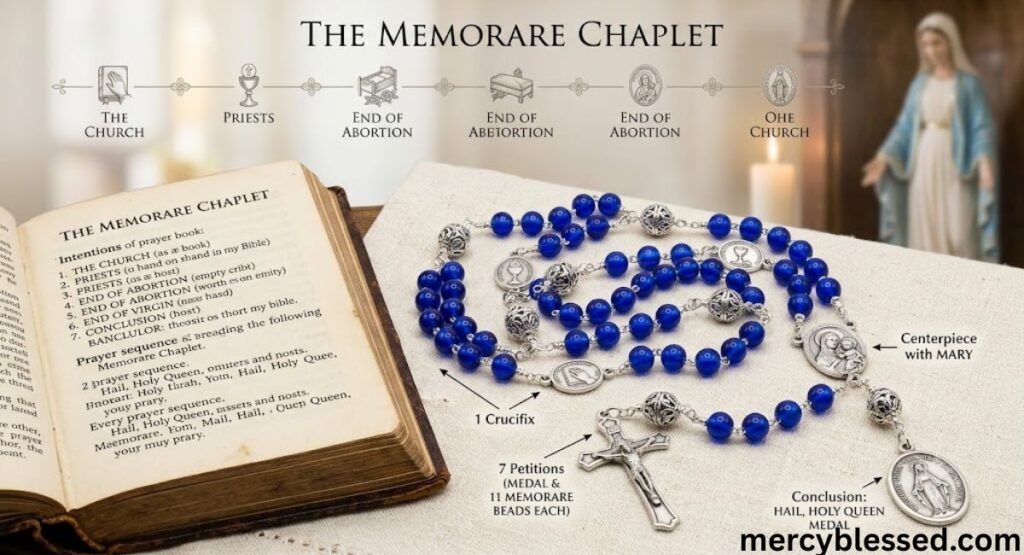
Beyond being recited on its own, the Memorare has inspired a distinct devotional practice known as the Memorare Chaplet, sometimes called the “Flying Novena” or “Emergency Novena.”
What Is the Memorare Chaplet?
<cite index=”8-1″>The Memorare Chaplet is best known through the practice of St. Teresa of Calcutta (Mother Teresa), who prayed it whenever she faced an urgent situation without time for a full nine-day novena.</cite> <cite index=”9-1″>Her method — nine Memorares prayed in a row for a petition, followed by a tenth prayed in thanksgiving — became known as the “Flying Novena.”</cite>
<cite index=”11-1″>This tradition continues today among the Missionaries of Charity, the religious order Mother Teresa founded.</cite>
How to Pray the Memorare Chaplet
- Begin with the Sign of the Cross.
- Silently or aloud, state your intention.
- Recite the Memorare nine times in a row, focusing on your petition.
- Pray a tenth Memorare in thanksgiving, trusting that your request has been heard.
- Close with the Sign of the Cross.
Some versions of the chaplet also include an Our Father, Hail Mary, and Glory Be after each Memorare, particularly when prayed as part of a structured nine-day novena rather than the condensed “flying” version.
Why Nine Memorares?
The number nine echoes the traditional nine-day novena format common throughout Catholic devotional life. Praying the Memorare nine times condenses that same spirit of persistent, trusting prayer into a single sitting — ideal for moments when there’s no time to spare but faith is urgently needed.
Using Prayer Beads for the Chaplet
While the Memorare Chaplet doesn’t require special beads, some people use a simple ten-bead ring or decade of a rosary to keep count, similar to counting a Rosary decade. This isn’t required, but it can help maintain focus during the nine repetitions.
FAQs
Who wrote the Memorare prayer?
The prayer is popularly attributed to St. Bernard of Clairvaux, though this is historically inaccurate. Its modern form was popularized by Fr. Claude Bernard in the 17th century.
What does “Memorare” mean in English?
Memorare is Latin for “remember,” reflecting the prayer’s opening request that Mary recall her role as an intercessor for those in need. (Memorare Prayer)
When should I pray the Memorare?
It can be prayed at any time, but it’s especially popular during moments of urgent need, illness, fear, or major life decisions. (Memorare Prayer)
Is the Memorare an official Catholic prayer?
Yes. It’s referenced in the Catechism of the Catholic Church (§2677) as an example of confident petition to Mary.
What is the Memorare Chaplet or “Flying Novena”?
It’s the practice of praying the Memorare nine times in a row for a petition, followed by a tenth in thanksgiving — a method associated with St. Teresa of Calcutta. (Memorare Prayer)
Can non-Catholics pray the Memorare?
Yes. While it’s rooted in Catholic Marian devotion, anyone drawn to its message of trust and comfort is welcome to pray it.
Conclusion
The Memorare Prayer endures because its message is timeless: no one who turns to Mary in genuine need is left without help. Whether prayed once in a moment of crisis or recited daily as part of a lifelong devotion, its short, sincere words continue to offer comfort to millions. Understanding its history and structure — and even trying the Memorare Chaplet — can deepen how meaningful this centuries-old prayer becomes in your own spiritual life.

hi