


Grit Meaning: You have probably heard someone say, “She’s got grit.” It sounds like praise, but what does it actually mean? The word also shows up on sandpaper packs and road safety signs, which makes it more confusing.
This guide explains every meaning of grit in plain English. You will also find its pronunciation, origin, example sentences, and similar words.
Quick Answer
Grit means courage, determination, and the strength to keep going when things are hard. It can also mean tiny, rough pieces of sand or stone. As a verb, it means to clench your teeth or to spread grit on a surface, such as an icy road.
Quick Meaning Table
| Form | Meaning | Example |
|---|---|---|
| Noun | Courage and determination | “It took real grit to finish the race.” |
| Noun | Tiny pieces of sand or stone | “There was grit in my shoe.” |
| Verb | To clench your teeth | “He gritted his teeth and kept walking.” |
| Verb | To spread grit on a surface | “The council gritted the roads before the frost.” |
What Does Grit Mean?
Grit has two main senses, one about character and one about material.
In the first sense, grit is a person’s inner strength. It is the quality that keeps you working toward a goal even when you are tired, scared or failing.
In the second sense, grit is small, hard particles. Think of sand, gravel or the rough surface of sandpaper. The word can also name a coarse sandstone called gritstone. (Grit Meaning)
The two senses are linked. Rough, tough particles became a picture for a rough, tough character.
Grit Meaning in Simple Words
Here is the easiest way to remember it:
- Grit = never giving up.
- It is staying power plus bravery.
- It is doing the hard thing again tomorrow.
If someone says you have grit, they are saying you are tough and committed. People don’t usually say it about someone who quits at the first problem.
Different Meanings of Grit
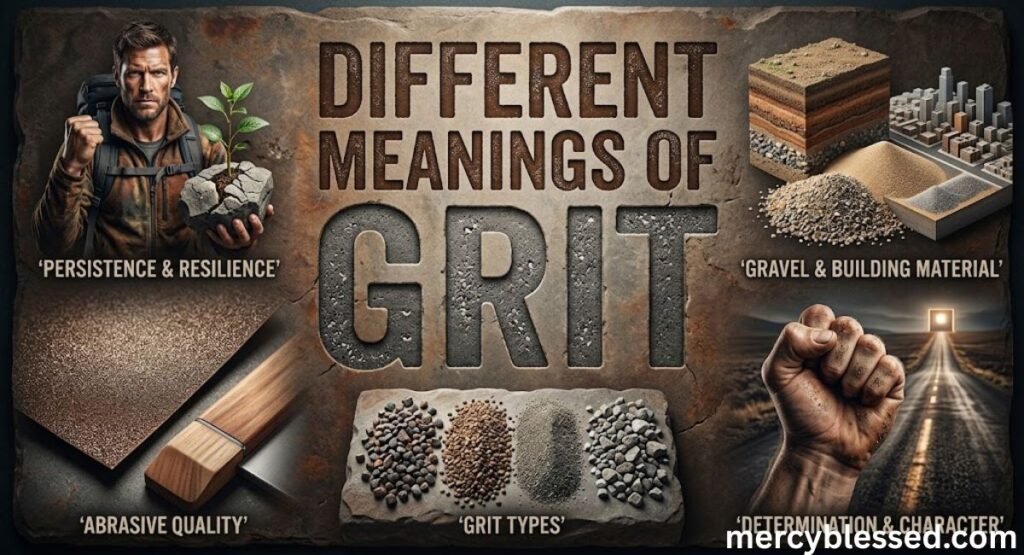
1. Grit as Courage and Determination
This is the most common meaning today. Grit is a mix of courage, perseverance, and passion for long-term goals. A gritty person sticks with a task through setbacks.
Psychologist Angela Duckworth made the idea widely known. Her research and her 2016 book describe grit as passion and perseverance for long-term goals. She argues that effort and staying power often matter as much as natural talent.
Some features of this kind of grit:
- Staying focused on a long-term goal
- Bouncing back after failure
- Working hard without constant praise
- Finishing what you start
2. Grit as Small Pieces of Stone or Sand
In everyday and technical use, grit means fine, hard particles.
- Dust or sand stuck in your food or eyes
- The coarseness of sandpaper (for example, “80-grit” is rough and “400-grit” is fine)
- Sand or salt spread on icy roads
- Gritstone, a hard, coarse-grained sandstone used in building (Grit Meaning)
3. Grit as a Verb
As a verb, grit has two common uses.
- To cover with grit. “Workers gritted the pavements after the snowfall.” This use is especially common in British English.
- To clench or grind together. This is where the next phrase comes from.
4. Grit Your Teeth
To grit your teeth means to press them together tightly. People do it when they are in pain, angry or trying to stay strong.
It is also used figuratively. If you “grit your teeth” through a boring meeting, you force yourself to get through something unpleasant without complaining.
The correct past form is gritted, as in “She gritted her teeth and carried on.”
How to Pronounce Grit
Grit is pronounced /ɡrɪt/, and it rhymes with sit, hit and bit.
- Break it down: “grih” + “t”. There is only one syllable.
- Common mistake: Don’t stretch the vowel into “greet.”
Origin of Grit
The word has deep roots. It comes from the Old English greot, meaning sand, dust, earth or gravel. That came from an older Germanic root for tiny crushed bits of rock, which traces back to an ancient root meaning “to rub or grind.”
The meaning of courage appeared much later. By the early 1800s, people in American English were using “grit” to describe a person with a hard, unbreakable spirit, as in “having the grit to stand up for yourself.” The picture was simple: someone made of rough stone is hard to break.
How to Use Grit in a Sentence

Here are examples for each meaning:
Courage and determination
- She showed real grit by returning to school at 40.
- The team’s grit helped them win after a terrible start.
- Success often takes more grit than talent.
Small stones or sand
4. I could feel grit between my teeth after the beach picnic.
5. Choose a finer grit of sandpaper for the final polish.
Verb uses
6. He gritted his teeth as the doctor cleaned the wound.
7. The roads were gritted early this morning. (Grit Meaning)
Conversation Examples
Conversation 1
Maya: Did you see Ali finish the marathon with a sprained ankle?
Sam: I did. That took serious grit.
Maya: Totally. Most people would have quit at mile ten.
Conversation 2
Dad: Why is there sand all over the kitchen floor?
Ben: Sorry, it’s grit from my sandals.
Dad: Please sweep it up before it scratches the floor.
Synonyms and Similar Words
If you want a different word for grit, these are your best options. Each one has a slightly different feel.
Determination
A firm decision to reach a goal. “Her determination got her through law school.”
Perseverance
Continuing despite difficulty or delay. “Perseverance turned his small shop into a brand.”
Courage
The ability to act despite fear. “It took courage to speak up.”
Persistence
Steady effort that does not stop. “Persistence paid off when the job offer finally came.”
Resilience
The ability to recover quickly from hardship. “The town showed resilience after the flood.”
Tenacity
A stubborn, firm hold on a goal. “The lawyer’s tenacity impressed the judge.”
Informal alternatives include guts, backbone, nerve, spirit, moxie and gumption.
Common Confusions
Grit vs. Gritty
Grit is the noun (the quality or the particles). Gritty is the adjective. It can mean sandy (“gritty texture”), tough and determined (“a gritty performance”), or realistic and harsh (“a gritty crime drama”).
Grit vs. Grief
These look similar but are unrelated. Grief is deep sadness, usually after a loss. Grit is strength and determination. A person can show grit while dealing with grief.
Grit vs. Grip
Grip means to hold something firmly, or a firm hold. Grit is about courage or tiny particles. They share letters and sound similar, so people sometimes mix them up in writing. (Grit Meaning)
Grit vs. Grits
Grits is a plural noun for a Southern American dish of coarsely ground corn, often served hot for breakfast. The two words share the same ancient root, which meant coarsely ground material. They have since developed separate meanings.
Is Grit a Positive Word?
Yes, in most cases grit is a positive word. When used about a person, it signals admirable toughness and perseverance. Teachers, coaches and employers often use it as praise.
There are two small exceptions:
- When it means sand or stone particles, it is neutral or even negative. Nobody wants grit in their food.
- Some critics say too much focus on grit can ignore real obstacles like poverty or lack of support. Effort matters, but circumstances matter too.
FAQs
What is the simple meaning of grit?
Grit means courage and determination to keep going despite difficulty. It can also mean tiny pieces of sand or stone. (Grit Meaning)
What does “she has grit” mean?
It means she is tough, brave and determined. She does not give up easily.
What does it mean to grit your teeth?
It means to clench your teeth, often because of pain or anger. Figuratively, it means to push through something unpleasant.
Is grit the same as perseverance?
Not exactly. Perseverance is continuing despite difficulty, while grit also includes courage and passion for a long-term goal.
What is grit in psychology?
In psychology, grit is passion and perseverance for long-term goals. Angela Duckworth made the concept popular.
What is the past tense of grit?
The past tense is gritted, as in “He gritted his teeth.” (Grit Meaning)
What does grit mean on sandpaper?
It is the number that shows how coarse the paper is. Lower numbers are rougher, and higher numbers are finer.
Where does the word grit come from?
It comes from the Old English “gret,” meaning sand or gravel. The courage sense developed later, around the early 1800s.
Can grit be learned?
Yes. Most researchers believe habits like goal setting, practice, and learning from failure can build grit over time.
Conclusion
Grit means two things: courage and determination in a person, and tiny, hard particles like sand or stone. As a verb, it means to clench your teeth or to spread grit on a surface.
The meaning of courage is the one most people care about. It is the quality that carries you through hard days, long projects and big setbacks. Now that you know the word’s meanings, origin and related terms, you can use it with confidence. When you next say someone has grit, you will know exactly what you are praising.

hi