

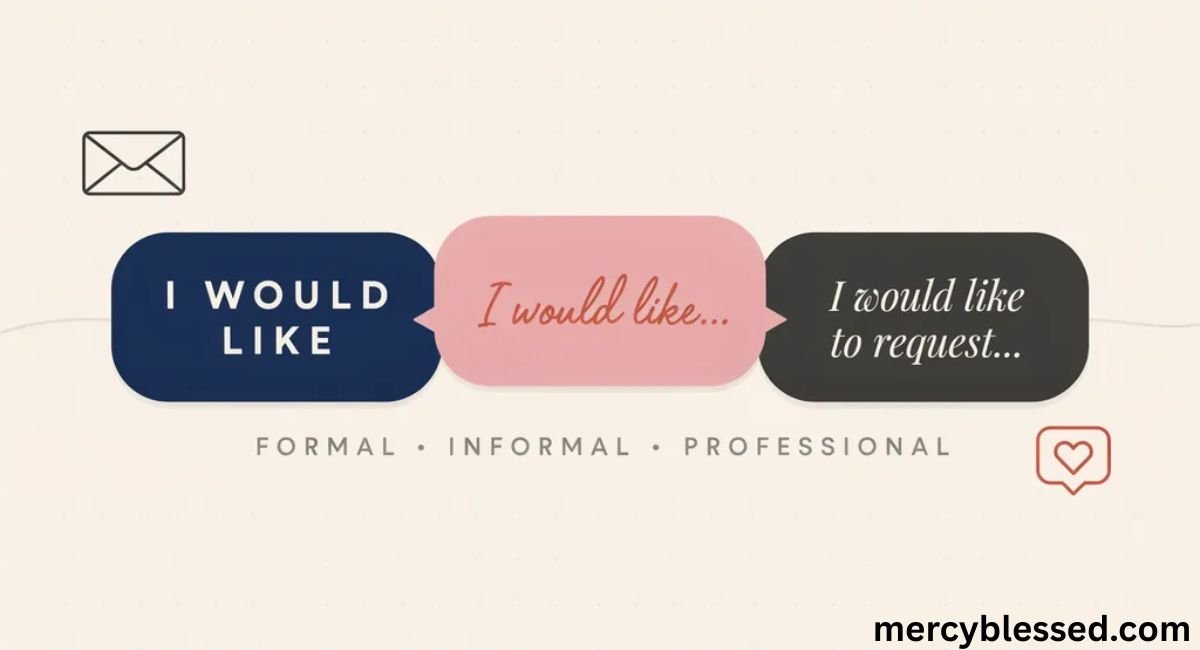
“I would like” is one of the most common phrases in English, but using it over and over again can make your writing sound flat and repetitive. Whether you’re drafting a business email, chatting with friends, or preparing for a job interview, knowing how to vary this phrase can make you sound more natural, confident, and polished.
In this guide, you’ll find 27+ alternatives to “I would like,” organized by tone and situation, along with examples, mini dialogues, common mistakes, and a handy comparison table to help you pick the right phrase every time.
What Does “I Would Like” Mean?
“I would like” is a polite way of expressing a wish, desire, or request. It softens a statement so it doesn’t sound like a demand. For example, saying “I would like a coffee” sounds far more courteous than simply saying “Give me a coffee.”
Grammatically, it’s a conditional construction (would + like) that adds a layer of politeness to the verb “want.” This is why it’s so widely used in formal writing, customer service, and everyday conversation alike.
When to Use “I Would Like”
You can use “I would like” in almost any situation where you want to express a preference, request, or intention politely. Common scenarios include:
- Ordering food or drinks at a restaurant
- Making requests in emails or letters
- Asking for information or assistance
- Expressing future plans or goals
- Starting a polite conversation with someone you don’t know well
While versatile, repeating the same phrase across an email or conversation can feel monotonous — which is exactly why alternatives come in handy.
Is “I Would Like” Polite or Professional?
Yes, “I would like” is both polite and professional. It works well in formal emails, job applications, and customer interactions because it softens requests without sounding pushy.
However, it isn’t always the best choice. In very casual settings, it can sound stiff, and in highly formal documents, you may want something even more refined, like “I wish to” or “I would appreciate the opportunity to.”
Pros & Cons of Using “I Would Like”
| Pros | Cons |
|---|---|
| Polite and widely accepted | Can sound repetitive if overused |
| Suitable for formal and semi-formal writing | May feel slightly stiff in casual chats |
| Easy to understand across cultures | Lacks urgency in time-sensitive requests |
| Works in spoken and written English | Doesn’t always convey enthusiasm |
Quick Alternatives List
Here’s a fast-reference list of alternatives covered in this article:
- I wish to
- I want to
- I am interested in
- I’d love to
- I hope to
- I am keen to
- I aim to
- I desire to
- I plan to
- I prefer
- I’m looking forward to
- I request
- I’d be happy to
- I’d appreciate the chance to
- I intend to
- I’m willing to
- I’d enjoy
- I’m excited to
- I would appreciate it if
- I’d like to try
- I feel like
- I’m hoping to
- I’d be glad to
- I am eager to
- I would be grateful if
- I’m thinking about
- I’d rather
- I would welcome the opportunity to
See also: Cudgel Meaning: What It Really Means in Text, Chat, and Everyday Language
Main Alternatives
1. I Wish To
Meaning: A formal way to express a desire or intention.
Example: “I wish to speak with the manager regarding my complaint.”
Best Use: Formal letters, official emails
Tone: Formal, polite
2. I Want To
Meaning: A direct, straightforward way to express desire.
Example: “I want to finish this report before lunch.”
Best Use: Casual conversations, informal messages
Tone: Friendly, casual
3. I Am Interested In
Meaning: Shows curiosity or a desire to learn more or get involved.
Example: “I am interested in discussing potential collaboration opportunities.”
Best Use: Business emails, networking
Tone: Professional, neutral
4. I’d Love To
Meaning: Expresses enthusiasm and genuine interest.
Example: “I’d love to join the team for lunch tomorrow.”
Best Use: Friendly conversations, social invitations
Tone: Warm, enthusiastic
5. I Hope To
Meaning: Expresses a wish for something to happen, often with a hint of optimism.
Example: “I hope to hear from you soon regarding the position.”
Best Use: Formal emails, follow-ups
Tone: Polished, hopeful
6. I Am Keen To
Meaning: Shows eagerness and motivation.
Example: “I am keen to learn more about your company’s culture.”
Best Use: Job interviews, professional introductions
Tone: Enthusiastic, professional
7. I Aim To
Meaning: Expresses a goal or objective.
Example: “I aim to complete the project ahead of schedule.”
Best Use: Reports, performance reviews, goal-setting
Tone: Confident, formal
See also: Chimba Meaning: What It Really Means in Chat and Text (Updated for 2025)
8. I Desire To
Meaning: A strong, formal expression of wanting something.
Example: “I desire to expand my knowledge in this field.”
Best Use: Formal writing, academic statements
Tone: Very formal — avoid in casual chats
9. I Plan To
Meaning: Indicates a definite intention or future action.
Example: “I plan to attend the conference next month.”
Best Use: Business updates, scheduling
Tone: Professional, clear
10. I prefer
Meaning: Expresses a choice between options.
Example: “I prefer to handle this matter over the phone.”
Best Use: Decision-making conversations, polite preferences
Tone: Neutral, assertive
11. I’m Looking Forward To
Meaning: Expresses excitement about something upcoming.
Example: “I’m looking forward to our meeting next week.”
Best Use: Emails, closing remarks
Tone: Friendly, professional
12. I Request
Meaning: A direct and formal way of asking for something.
Example: “I request a copy of the signed contract at your earliest convenience.”
Best Use: Official letters, formal applications
Tone: Formal, firm
Mini Dialogue Examples
Formal: A: “I would like to discuss the project timeline.” B: “Of course, let’s set up a meeting tomorrow.”
Informal: A: “I’d love to grab coffee later.” B: “Sounds great, let’s go!”
Professional Email: “I am interested in exploring partnership opportunities between our companies. Could we schedule a call next week?”
Mistakes to Avoid
- Overusing “I would like” throughout a single email or conversation
- Using overly formal phrases like “I desire to” in casual texts or with friends
- Mixing up “I want” with polite requests in professional settings
- Forgetting to match your tone with the relationship and context
- Using contractions (like “I’d”) in highly formal or legal documents
Cultural & Tone Tips
Politeness norms vary across English-speaking cultures. British English tends to favor more indirect, softened phrasing, such as “I was wondering if” or “Would it be possible to.” American English is often slightly more direct but still values courtesy in professional settings.
When writing internationally, it’s safer to lean toward formal alternatives, especially in first-time business communication. Once a relationship is established, you can gradually shift to warmer, more casual expressions.
See also: Gait Meaning: What It Really Means in Chat, Text, and Everyday Life
Comparison Table
| Phrase | Tone | Best Use | Formality Level |
|---|---|---|---|
| I wish to | Formal | Letters, emails | High |
| I want to | Casual | Everyday speech | Low |
| I am interested in | Professional | Business, networking | Medium-High |
| I’d love to | Warm | Social invitations | Low-Medium |
| I hope to | Polished | Follow-ups | Medium-High |
| I am keen to | Enthusiastic | Interviews | Medium-High |
| I aim to | Confident | Goal statements | High |
| I desire to | Very formal | Academic writing | Very High |
| I plan to | Clear | Updates, scheduling | Medium |
| I prefer | Assertive | Decisions | Medium |
| I’m looking forward to | Friendly | Closings | Medium |
| I request | Firm | Official letters | High |
Conclusion
Mastering alternatives to “I would like” helps your writing feel fresh, natural, and tailored to the situation. Whether you’re sending a formal request, chatting casually, or writing a professional email, choosing the right phrase shows attention to tone and audience — a small change that makes a big difference in how your message is received.
Try mixing a few of these alternatives into your next email or conversation, and notice how much more dynamic your communication becomes.
FAQs
Is “I would like” formal or informal?
It’s considered semi-formal to formal, suitable for both polite conversation and professional writing.
What’s the best alternative for job interviews?
“I am keen to” or “I am interested in” work especially well, as they convey enthusiasm and professionalism.
Can I use “I’d love to” in business emails?
Yes, but only in friendly or informal business contexts — it may feel too casual for very formal correspondence.
What’s a more formal way to say “I want”?
“I wish to,” “I desire to,” or “I aim to” are all more formal alternatives to “I want.”
How do I avoid sounding repetitive in emails?
Vary your phrasing using alternatives like “I plan to,” “I hope to,” or “I’m looking forward to” depending on context.

hi