

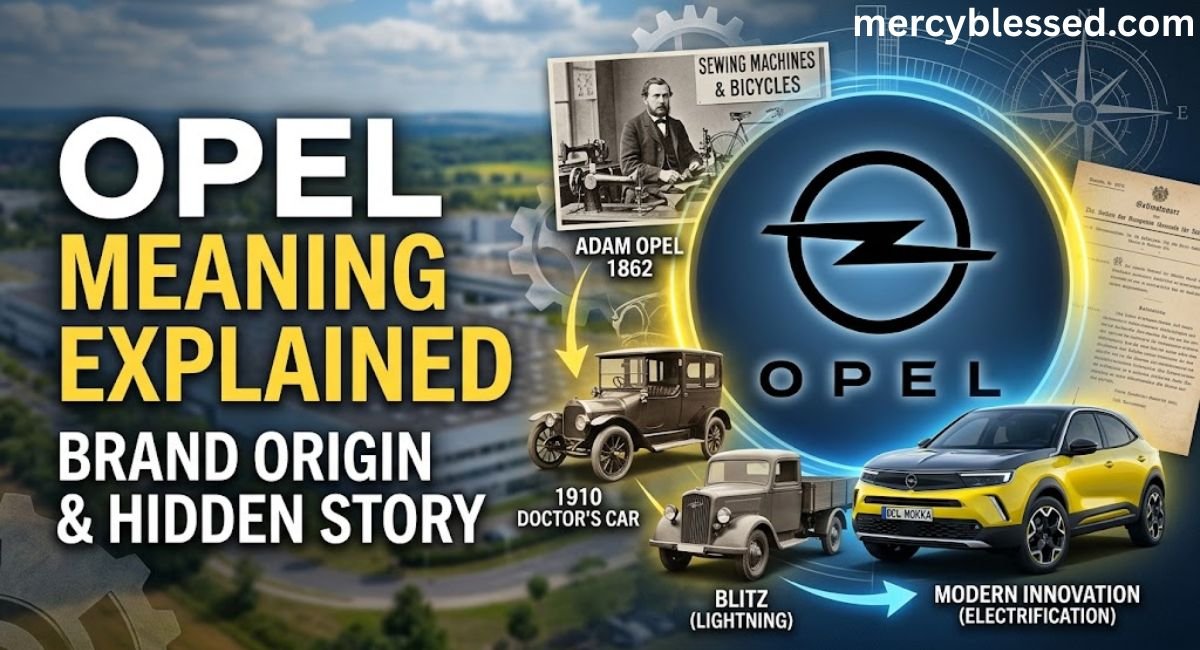
If you’ve ever glanced at a badge on a European car and wondered, “What does ‘Opel’ actually mean?” you’re not alone. The Opel meaning is more layered than a simple dictionary definition—part surname, part industrial legend, part design story stretching back more than 160 years.
This guide covers everything the word “Opel” represents, from its German roots to the lightning-bolt logo and a few unexpected corners, like knitting forums, where the word also pops up.
OPEL Meaning in the Automotive World
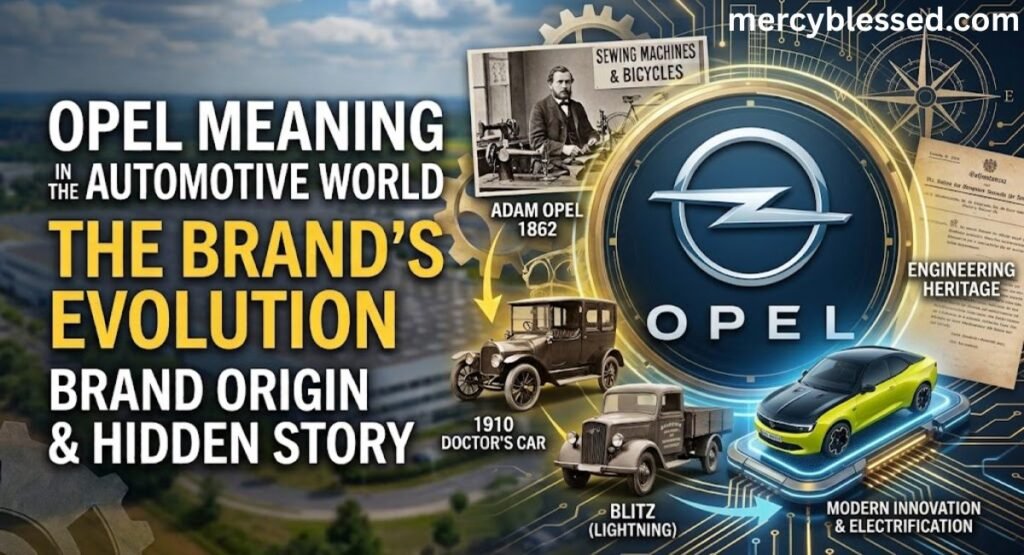
In the automotive world, Opel is not an acronym or a translated word—it’s a surname turned brand name. The company is named directly after its founder, Adam Opel, a German locksmith and machinist who started a small workshop in 1862.
Today, Opel is recognized as one of Germany’s oldest and most influential car manufacturers, known for producing practical, well-engineered passenger cars, SUVs, and electric vehicles primarily sold across Europe.
Quick Facts About Opel
| Detail | Information |
|---|---|
| Founder | Adam Opel |
| Founded | 1862 (as a sewing machine workshop) |
| First automobile | 1899 |
| Headquarters | Rüsselsheim am Main, Germany |
| Current parent company | Stellantis (formerly General Motors, then PSA Group) |
| Logo symbol | Lightning bolt (“Blitz”) in a circle |
| Known for | Compact and mid-size cars, engineering efficiency |
OPEL Car Brand Meaning
As a car brand, Opel means “centers” on German engineering heritage rather than any literal translation. The name doesn’t describe a car feature—it simply honors the man who built the company from the ground up.
Over time, “Opel” evolved from a family surname into a trademark associated with:
- Reliable, mass-produced vehicles for everyday drivers
- Early adoption of assembly-line manufacturing in Germany
- A long history of innovation, including some of Europe’s first affordable compact cars
So when someone asks what Opel stands for as a brand, the honest answer is a family legacy that grew into an industrial powerhouse.
Is Opel a German Company?
Yes, Opel is a German company through and through. It was founded in Rüsselsheim, Germany, and the headquarters remain there today. While ownership has changed hands over the decades—from the Opel family, to General Motors in 1929, to France’s PSA Group in 2017, and now to Stellantis—the brand’s engineering base and manufacturing roots stay firmly German. That’s worth knowing, since shoppers often assume Opel is French or American based on its more recent corporate owners.
Opel Word Origin & Linguistic Meaning
The word origin of “Opel” is genuinely debated among linguists and genealogy researchers, and no single explanation is universally accepted. The most cited theories include
- Medieval German surname roots—a shortened form of older Germanic names, possibly linked to elements meaning “wealth” or “fortune” combined with “peace.”
- Old High German origin—connected to a word meaning “to help” or “to aid.”
- Occupational or regional surname—a Middle High German surname developed from local or trade-based naming traditions.
Because medieval surname origins were rarely documented formally, interpretations vary by source. What’s consistent is that every credible source agrees the name is German.
Opel Meaning in German
In everyday modern German, “Opel” isn’t a common noun—you won’t find it in a standard dictionary as a word for an object or idea. It functions purely as a proper noun: a family name and, overwhelmingly, the name of the automaker. If a German speaker hears “Opel,” their first association will almost always be the car brand, not a hidden translation.
Opel Name Meaning in Different Contexts
Because “Opel” is short and phonetically simple, it shows up in a few unrelated contexts beyond cars:
| Context | Meaning or Association |
|---|---|
| Automotive industry | German car manufacturer founded by Adam Opel |
| Baby names / given names | Rare given name, sometimes listed with meanings like “jewel” (Sanskrit baby-name lists) |
| Surname databases | German/Jewish Ashkenazic surname, occasionally linked to “hop vine” |
| Word puzzles | Sometimes used as a near-homophone of “opal,” the gemstone |
| Textile and clothing brands | Occasionally used as a business or shop name, unrelated to any official stitch or technique |
Opel Logo Meaning & Symbolism
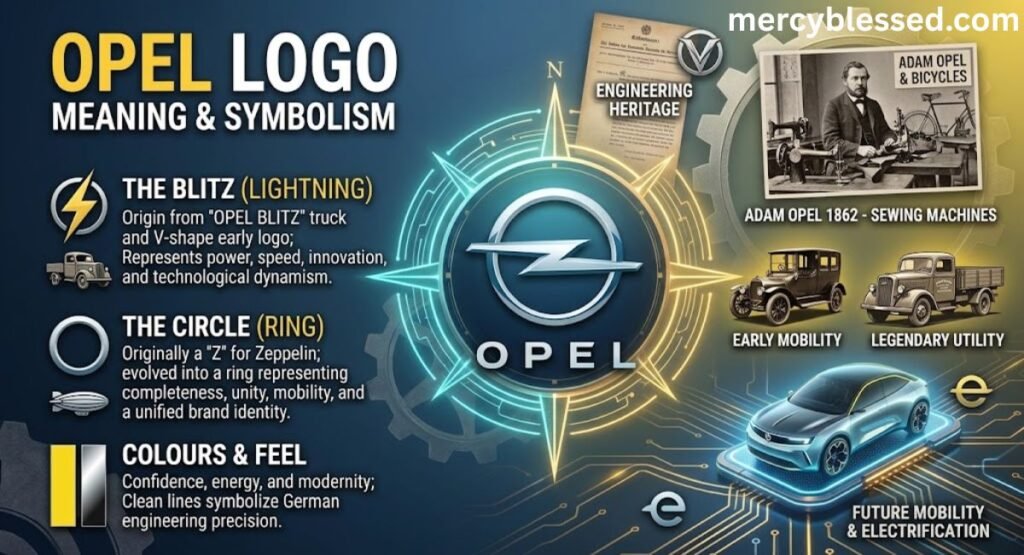
The Opel logo has one of the more interesting design histories in the auto industry, and its meaning has shifted with the times.
What Does the Opel Logo Mean?
The current logo features a lightning bolt inside a circle—a symbol Opel calls the “Blitz,” German for “lightning.” It communicates speed, energy, and forward motion, values the brand has leaned into since the mid-20th century.
The lightning bolt wasn’t the original idea, though. In the 1930s, Opel used a stylized zeppelin (airship) emblem, reflecting Germany’s fascination with aviation at the time. As design trends shifted toward simpler, abstract shapes, the airship evolved into the sleeker lightning bolt that debuted in the 1960s and has anchored the brand identity ever since.
Symbol Meaning:
- Lightning bolt—Speed, power, and modern engineering
- Circle—Unity, wholeness, and completeness
- Yellow and black color scheme (used historically) — Energy, visibility, and approachability
Opel Symbol Meaning in Branding
From a branding perspective, the Opel symbol works because it’s simple enough to recognize at a glance yet distinctive enough to avoid confusion with competitors. Few other automakers use a lightning bolt as a primary emblem, giving Opel a visual identity that’s hard to mistake for anyone else’s. The symbol also ties back to product history—Opel had already built a successful delivery-truck line called the Opel Blitz in the 1930s, so the logo reinforced a name customers already knew.
What Does OPEL Stand For?
This is one of the most-searched questions about the brand, and the answer often surprises people: Opel doesn’t stand for anything as an acronym. It’s simply the founder’s family name, Adam Opel, used as the company name from day one in 1862. Any claim that OPEL stands for a catchy phrase online is an invented backronym, not factual history.
Opel Meaning in the Automotive Industry
Within the broader automotive industry, Opel meaning carries connotations of practical, value-driven German engineering. Unlike luxury-focused German brands, Opel built its identity around affordable, everyday vehicles, efficient manufacturing, and a strong presence in compact and family car segments. This positioning shapes how the brand is perceived across Europe, where Opel (badged as Vauxhall in the UK) remains a familiar, trusted name rather than a status symbol.
Opel History and Brand Story
Opel’s story doesn’t start with cars—it starts with sewing machines. Adam Opel, born in 1837, trained as a locksmith and machinist before founding his workshop in Rüsselsheim in 1862, later expanding into bicycles. He passed away in 1895, before the company built its first car. It was his five sons who carried the business into automobile manufacturing, producing Opel’s first car in 1899. The brand grew rapidly, becoming one of Germany’s largest carmakers and catching the attention of General Motors, which acquired a majority stake in 1929.
Timeline of Opel
| Year | Milestone |
|---|---|
| 1862 | Adam Opel founds his workshop, producing sewing machines |
| 1886 | Opel begins manufacturing bicycles |
| 1895 | Adam Opel passes away; his sons take over the business |
| 1899 | Opel produces its first automobile |
| 1929 | General Motors acquires a majority stake in Opel |
| 1930s | Zeppelin logo era; the Opel Blitz truck line launches |
| 1960s | The lightning bolt (“Blitz”) logo is introduced |
| 2017 | PSA Group (Peugeot parent company) acquires Opel from GM |
| Today | Opel operates under Stellantis, GM’s successor as parent group |
Opel vs Other Car Brands
People often compare Opel’s name origin to other German manufacturers:
| Brand | Origin of Name | Market Position |
|---|---|---|
| Opel | Founder’s surname (Adam Opel) | Mass-market, practical family vehicles |
| Volkswagen | German for “people’s car” | Mass-market, historically state-backed |
| BMW | Acronym for Bavarian Motor Works | Premium/luxury performance |
| Mercedes-Benz | Combination of a founder’s daughter’s name and a co-founder’s surname | Luxury and premium engineering |
| Audi | Latin translation of founder August Horch’s surname | Premium, technology-focused |
Like several German automakers, Opel’s name has personal roots rather than a marketing-invented phrase — a pattern common in the industry’s early history.
Opel Meaning in Knitting & Textiles
This is where the search results get a little unusual. Some people search “Opel meaning” expecting a knitting or sewing term, likely because the word sounds similar to established textile terms.
Opel Stitch Meaning
To be clear: there is no recognized knitting or sewing technique officially called an “Opel stitch.” This is likely mistaken association with common stitches like purl, or confusion with small clothing brands that have used “Opel” as a business name. If you’re after a specific textile technique, knit, purl, or whip stitch are probably what you actually mean.
Opel Meaning in Slang or English Usage
In casual English, “Opel” doesn’t carry any established slang meaning. It hasn’t crossed into internet slang, texting abbreviations, or idiomatic phrases. The main associations are the German car brand (by far the most common), an uncommon given name on baby-name lists, and a near-homophone of “opal,” which sometimes causes mix-ups in casual conversation or puzzles.
Opel Pronunciation & Meaning
English speakers often say the name differently than native German speakers do.
- German pronunciation: “OH-pel,” with a short, clean vowel sound
- Common English mispronunciation: “OH-pull,” or a blend with “opal”
Neither version changes the meaning, but pronouncing it closer to the German original is more accurate.
Why People Search “OPEL Meaning” Online
Search interest in “Opel meaning” tends to come from overlapping groups: car shoppers researching a brand’s background, name and etymology enthusiasts, trivia seekers wondering if Opel is an acronym, design fans curious about the logo, and even parents exploring Opel as a rare baby name. Because the word touches automotive history, linguistics, and branding all at once, it naturally draws a wide audience.
Conclusion
At its core, the Opel meaning comes down to one German craftsman’s surname that grew into a globally recognized automotive brand. There’s no hidden acronym, no secret translation—just a founder named Adam Opel, a sewing-machine workshop that became a car company, and a lightning-bolt logo that has represented speed and German engineering for decades. Whether you came for the history, the logo symbolism, or a pronunciation debate, Opel is a reminder that even the simplest brand names can carry over a century of history behind them.
FAQs
What does OPEL stand for?
Opel does not stand for anything as an acronym. It’s the surname of founder Adam Opel, used as the company name since 1862.
Is Opel a German or American brand?
Opel is a German brand, headquartered in Rüsselsheim, Germany, even though it was owned by America’s General Motors from 1929 to 2017.
What does the Opel logo mean?
The logo shows a lightning bolt (“Blitz”) inside a circle, symbolizing speed, energy, and German engineering precision.
Is there an Opel stitch in knitting?
No, there is no officially recognized “Opel stitch.” This is a common misconception, likely confused with terms like the purl stitch.
How do you pronounce Opel correctly?
The correct German pronunciation is “OH-pel,” though many English speakers say it closer to “OH-pull.”
Who founded Opel and when?
Adam Opel founded the company in 1862, originally as a sewing machine manufacturer, before it moved into bicycles and then automobiles.

hi